The Chenango-Delaware-Otsego Workforce is the agency to link employers with workers, and workers with the resources they need to develop their careers.

CDO Workforce coordinates and focuses employment, training and education development resources across three counties, providing service to employed people, unemployed people and employers alike. Our goal is to improve the long-term growth and development of the work force.

CDO Workforce News & Blog

Chenango-Delaware-Otsego Workforce News & Blog

The Official Career Development Source for Employment, Training and Recruitment issues for Business and Individuals in Chenango, Delaware and Otsego Counties of New York State.

Helpful Information & Resources from NYSDOL

The New York State Department of Labor has issued a press release that includes helpful information and resources. 

Including:  

  • A new PSA that provides information on how to apply for unemployment benefits and reassures New Yorkers if their unemployment filing is delayed, they will still receive full unemployment benefits. The PSA is also available with Spanish subtitles  
  • How to claim unemployment benefits  
  • Unemployment Insurance FAQs 
  • What you need to know and do About the CARES Act
  • and more

Go Here to Read the Press Release

Tags:
Continue reading

COVID-19 Information By and For People with Disabilities

Looking for plain language resources on the Corona Virus? 

Green Mountain Self-Advocates has created a guide written by and for people with disabilities. 

Go Here to See the Guide 

Tags:
Continue reading

COVID-19 and Social Insurance Programs

Includes information for SSI & SSDI recipients. 

Shared From cornell.edu: 

"With ongoing impact of covid-19 still not fully understood by the community at large, individuals with disabilities who regularly access a series of public benefits are left with a variety of questions about the impact of the various federal and state legislative and administrative actions on these various benefits. Key language in the Coronavirus Aid, Relief, and Economic Security Act (CARES Act) serves as a guidepost from which the impact on benefits can be better understood. 

Notwithstanding any other provision of law, any refund (or advance payment with respect to a refundable credit) made to any individual under this title shall not be taken into account as income, and shall not be taken into account as resources for a period of 12 months from receipt, for purposes of determining the eligibility of such individual (or any other individual) for benefits or assistance (or the amount or extent of benefits or assistance) under any Federal program or under any State or local program financed in whole or in part with Federal funds. 26 U.S. Code § 6409." 

Supplemental Security Income (SSI): Individuals who are receiving SSI need to be aware of several key elements related to the stimulus payment:

  1. Stimulus payments are NOT taxable.
  2. Stimulus payments received by the individual that are initiated through the Coronavirus Aid, Relief, and Economic Security Act (CARES Act) will not counts as income in the calculation of the individual’s SSI amount for that month(26 U.S. Code § 6409).
  3. Stimulus payments will not be counted as “resources” for a twelve month period following the receipt of the funds (26 U.S. Code § 6409).

Social Security Disability Insurance (SSDI), Disabled Widow(er) Benefits (DWB), Childhood Disability Benefits (CDB): The stimulus payment will have no impact on any of these Title II benefits: SSDI, DWB, CDB, and SSA Retirement. These benefits are classified as insurance benefits and are NOT impacted by unearned income. In addition, the stimulus payments will NOT be taxable.

Please note that Title II benefits are SSA benefits. SSI benefits are federal welfare benefits. At any time when the Act refers to “Social Security Benefits, “SSI” in not included unless specifically stated by the statute.

Supplemental Nutrition Assistance Program (SNAP): There is no impact on SNAP benefits due to the receipt of a stimulus payment in accordance with 26 U.S. Code § 6409.

Housing and Urban Development (HUD): There is no impact on HUD rent subsidies due to the receipt of the stimulus funds. Further, HUD housing does not consider an individual’s resources. Only the income produced by the resource, bank interest, is considered by HUD. *Please check your state rules concerning and state public housing in which an individual may be living.

HUD has also extended a “tailored set of mortgage payment relief options for single family homeowners with FHA-insured mortgages”. “Effective immediately for borrowers with a financial hardship that makes them unable to pay their mortgage due to the COVID-19 National Emergency, mortgage servicers must extend deferred or reduced mortgage payment options - called forbearance - for up to six months, and must provide an additional six months of forbearance if requested by the borrower”[1].

Medicaid: In all states that have accepted the Federal Medical Assistance Percentage (FMAP) 6.2% increase from the federal government (only NYS is in question), Medicaid recipients who received benefits before the COVID-19 crisis, or become eligible during the crisis cannot be terminated from Medicaid.

On a case by case basis, states may change the category or eligibility, e.g., from regular Medicaid to 1619(b) or Medicaid Buy-In for Working People with Disabilities (MBI-WPD), but terminations of coverage will not be allowed.

Medicare: The stimulus payment will have no impact on Medicare premiums or eligibility. Medicare Savings Plans (MSPs), those programs that see Medicaid paying all or part of Medicare premiums for Parts B and D, will also not be impacted by the stimulus payments in accordance with above language (26 U.S. Code § 6409).

Temporary Assistance for Needy Families (TANF): In accordance with the language in 26 U.S. Code § 6409, the stimulus payment will have no impact on TANF eligibility or resource levels for a 12 month period from receipt of the funds.

Unemployment Insurance (UI): Each state is responsible for establishing its own UI benefits eligibility. In general, individuals qualify when:

  • Are unemployed through no fault of your own. In most states, this means you have to have separated from your last job due to a lack of available work.
  • Meet work and wage requirements. You must meet your state’s requirements for wages earned or time worked during an established period of time referred to as a "base period." In most states, this is usually the first four out of the last five completed calendar quarters before the time that your claim is filed.
  • Meet any additional state requirements. Find details of your own state’s program. [2]

Important UI Facts: • UI has been extended beyond the “normal” 26 weeks to 39 weeks. *Note:  Massachusetts residents will receive 43 weeks as the Commonwealth provides 30 weeks of UI in normal circumstances.If your state pays other than 26 weeks in normal circumstances, simply add 13 weeks to the number of state weeks of payment

The federal government will also add $600 per week to the maximum state U/I benefit paid. For instance, if your state maximum payment is $450 per week, the weekly check will be $1045. There appears to be no variation in payment for those not receiving the maximum in your states so we must assume, until we receive other information that the $600 per week will be added to all UI amounts paid by the state.

For SSD/I workers with disabilities that will have to meet your state “base rate”; meaning that they have to have worked long enough and earned enough to be eligible for UI. See your state’s UI website for this information. Many websites also have calculators to estimate payments.

Important UI and SSI Facts: • SSI recipients are required to apply for any other benefit they may be eligible to receive when told of potential eligibility. The SSA Program Operations Manual System (POMS) states:

  • SSA advises him/her, on a written, dated notice, of potential eligibility for other benefits; and
  • He/she does not take all appropriate steps to file for and, if eligible, obtain any such payments within 30 days of receipt of such notice.

For those SSI recipients that meet your state’s UI “base period” the potential of receiving $2400 plus the state U/I benefit exists. SSI recipients could receive much more through the UI program than through the SSI program. Thus, they should be encouraged to apply ASAP for UI. Given that be maximum period of receipt of UI is 43 months, SSI recipients will still be suspended when UI ends. Please note:

  • At the conclusion of the UI, the recipient MUST call SSA to have the SSI reinstated.
  • Any EXCESS resources held at the time reinstatement is requested will count toward the resource limit.
  • Achieving a Better Life Experience (ABLE) accounts or other protected savings mechanisms could be considered, if eligible, to ensure SSI resource rules are met.

[1] HUD (2020, April 1). HUD issues new CARES act mortgage payment relief for FHA single family homeowners. HUD https://www.hud.gov/press/press_releases_media_advisories/HUD_No_20_048

[2] DOL (2020, April, 2). How do I file for unemployment insurance? DOL https://www.dol.gov/general/topic/unemployment-insurance

Released April 2, 2020

Tags:
Continue reading

Small Business Guide to the CARES Act from the U.S. Senate

The programs and initiatives in the Coronavirus Aid, Relief, and Economic Security (CARES) Act that was just passed by Congress are intended to assist business owners with whatever needs they have right now. 

When implemented, there will be many new resources available for small businesses, as well as certain nonprofits and other employers. This guide provides information about the major programs and initiatives that will soon be available from the Small Business Administration (SBA) to address these needs, as well as some additional tax provisions that are outside the scope of SBA. 

GO HERE TO READ THE GUIDANCE

Tags:
Continue reading

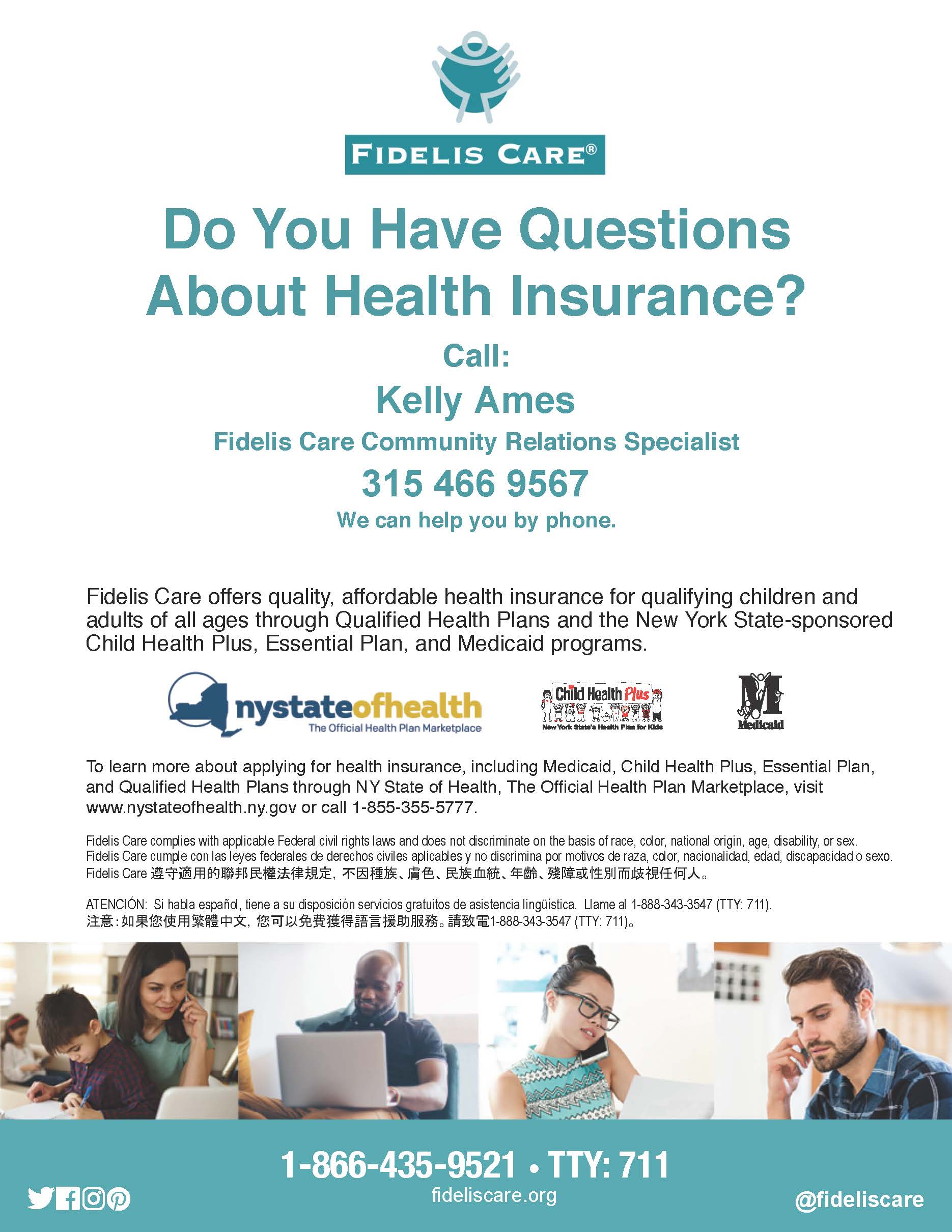
Health Care Enrollments: Catskill Center for Independence

Due to the current situation with the Covid-19 Virus, the Catskill Center for Independence Navigators are now taking phone applications only and are no longer conducting in person appointments. 

From the Catskill Center for Independence: 

"Although our presence in the community is not what you may be used to, we are still diligently working to meet your health care enrollment needs. 

New York State of Health has opened a SPECIAL ENROLLMENT PERIOD where everyone, regardless of their income, can apply for coverage. This special enrollment period is effective now through Aril 15, 2020 and includes Qualified Health Plans (those with metal levels). Of course enrollments in Medicaid, Child Health Plus and the Essential Plan are open year round. Please call one of our navigators to get the help you need in taking advantage of this special enrollment period as well as applying for Medicaid, Child Health Plus and the Essential Plan at any time during the year. 

Our Navigators are located in the following counties, but are able to assist consumers in any New York State County:

Schoharie County: Debbie Martin: 607-725-7256 Cheryl Plant: 607-437-0265

Delaware County: Shelly VanDerwerken: 607-435-7645

They are available Monday through Friday from 8-4 daily and are looking forward to assisting you as you make your health care decisions. We thank you for your understanding during this time and hope you all stay safe and healthy".

Tags:
Continue reading

Our goal is to help job seekers not just find a job, but develop and manage a career. That means helping them when they have a job and when they are looking. We also strive to help employers find the workers they need quickly and the resources to improve training, workforce retention and workforce restructuring.

Follow Us

Navigation Tip

Please tap the arrow icons on the right side to expand categories and view sub-menu options.